


 Shop
Shop

French olive oil
Discover the finest extra virgin olive oil from France
When people think of France, they may first think of wine, cheese, fresh baguettes and refined cuisine. Yet olive oil also plays an important role in French cooking, especially in the sunny south. In Provence, a bottle of good extra virgin olive oil is almost always within reach. It is used for salads, fish, grilled vegetables, tapenade, ratatouille and, of course, with fresh bread.
France is not one of the world’s largest olive oil producers. Compared with countries such as Spain, Italy and Greece, production is relatively small. That is precisely why French olive oil occupies such a distinctive position. Many French olive groves are fairly small, and the oils are closely connected to their region, local olive varieties and the gastronomic traditions of the area.
There is therefore no single typical French olive oil. An oil made from Picholine olives from around Nîmes can be fresh, green and expressive, while an oil made from riper Tanche olives from Nyons may taste much softer and rounder. In Provence, varieties such as Salonenque, Aglandau, Bouteillan, Grossane and Cayon come together in oils that combine elegance with herbs, almond and a refined peppery finish.
At De Olijfolie Shop, we select French extra virgin olive oils with a clear origin and a distinctive character of their own. No anonymous mass-produced oils, but special oils from producers and châteaux that reflect the French landscape, craftsmanship and passion for gastronomy in every bottle.
Why French olive oil is so special
France has a long gastronomic tradition in which the quality and origin of ingredients play an important role. This applies to wine and cheese, but also to olive oil. French producers often speak of their terroir: the combination of soil, climate, landscape, olive varieties and human craftsmanship that gives a product its unique identity.
In southern France, olive trees often grow on dry, stony soils. Summers are warm and sunny, while the mistral can provide cooling air and ventilation. Olive trees sometimes have to work hard to find enough water and nutrients. This may limit the yield, but with careful harvesting it can produce olives with highly concentrated aromas.
French production is also highly fragmented. Alongside professional olive estates, there are many smaller producers and historic domains with limited groves. Some producers make only a relatively small amount of oil each year. As a result, the emphasis is often less on volume and more on origin, flavour and presentation.
This small-scale character does not automatically make French olive oil better than oil from other countries. Spain, Italy and Greece also produce exceptional top-quality olive oils. France mainly distinguishes itself through its regional traditions, local olive varieties and its almost natural connection with refined French cuisine.
A journey through the French olive-growing regions
French olive cultivation is concentrated mainly in the south of the country. The most important regions are Provence-Alpes-Côte d’Azur and Occitanie, although Corsica and the southern part of Auvergne-Rhône-Alpes also have centuries-old olive-growing traditions. Each region has its own climate, olive varieties and flavour profile.
Provence
Provence is the best-known olive-growing region in France. Its landscape of limestone hills, herbs, vineyards, cypress trees and ancient olive groves seems almost made for olive cultivation. Varieties such as Salonenque, Aglandau, Bouteillan, Cayon, Grossane and Picholine all grow here.
Provençal olive oil can be fresh and green, with aromas of freshly cut grass, artichoke, apple and herbs. Other oils are softer and rounder, with notes of ripe olive, almond and fruit. The exact character depends on the olive varieties used, the harvest time and the production method.
Vallée des Baux-de-Provence
The Vallée des Baux-de-Provence lies around the limestone hills of the Alpilles. Olive trees have shaped the landscape here for centuries. The protected olive oil from this area is made mainly from local varieties such as Salonenque, Aglandau, Grossane and Verdale des Bouches-du-Rhône.
The oils from this valley are known for their distinct regional character. They may offer aromas of freshly cut grass, artichoke, almond and herbs, with a beautiful balance between fruitiness, bitterness and pungency.
Aix-en-Provence and Haute-Provence
Around Aix-en-Provence, the combination of Aglandau, Cayanne and Salonenque is especially important. Further north, in Haute-Provence, Aglandau is often the dominant variety. This olive can produce powerful and aromatic oils with a green, herbal flavour and a clearly peppery finish.
The differences in altitude and cooler nights can slow down the ripening of the olives. Producers who harvest early often obtain less oil, but the oil they do produce tends to have more aroma, flavour and natural antioxidants.
Nîmes and Languedoc
In the area around Nîmes, Picholine is the best-known olive variety. It is used as a table olive, but also produces a highly distinctive olive oil. Picholine olive oil is often fresh and green, with notes of grass, herbs, apple and sometimes a clearly peppery finish.
Languedoc is also home to a wide variety of local olive varieties. The region is warm and dry, but it is influenced by both the Mediterranean Sea and the hills further inland. This allows producers to make very different styles of olive oil.
Nyons, Nice and Corsica
Nyons lies further north and is known for the Tanche olive. These olives are often harvested at a riper stage and usually produce a softer, rounder oil with aromas of ripe fruit, nuts and sometimes a lightly buttery character.
Around Nice, the Cailletier variety is particularly important. This olive is used for oil, table olives and olive paste. The oil is often refined and delicate, with a subtle fruity character.
Corsica also has its own distinctive olive culture. The island has ancient olive groves, local varieties and strong differences between coastal regions and the mountainous interior. Corsican oils can be mild and ripe, but also fresh and expressive, depending on the area and harvest time.
The best-known French olive varieties
France has dozens of local olive varieties. Many of them are closely connected to one specific production area. Some are used mainly for olive oil, while others are used both for oil and as table olives. This diversity is precisely what gives French olive oil such a wide range of flavour profiles.
Salonenque
Salonenque is a classic olive variety from Provence and plays an important role around Salon-de-Provence, Aix-en-Provence and the Vallée des Baux. The olive can produce an elegant and approachable oil with aromas of green apple, almond, fresh herbs and sometimes artichoke.
The bitterness and pepperiness are usually refined and well balanced. This makes Salonenque a beautiful match for delicate dishes such as fish, shellfish, mild cheeses, vegetables and light salads.
Picholine
Picholine is one of the best-known French olive varieties. The long green olive is popular as a table olive, but also produces an expressive extra virgin olive oil. Around Nîmes in particular, the variety is closely connected to the regional olive-growing tradition.
Picholine olive oil can taste fresh and green, with aromas of grass, herbs, green apple and sometimes leafy vegetables. The finish is often slightly bitter and clearly peppery. This makes the oil ideal with tomatoes, grilled vegetables, goat’s cheese, fish and poultry.
Aglandau
Aglandau is one of the most important olive varieties of Provence. The variety is also known by regional names, including Béruguette. The oil is often powerful, green and aromatic, with notes of artichoke, fresh grass, almond and herbs.
An early harvest of Aglandau can be distinctly bitter and peppery. This character is linked to the presence of natural polyphenols. The oil pairs well with robust vegetables, pulses, meat, potatoes and dishes with garlic or Provençal herbs.
Bouteillan
Bouteillan is found mainly in the Var and other parts of Provence. The olive generally produces a fragrant, fruity oil with green and herbal aromas. Depending on the harvest, notes of apple, pear, grass and almond may also emerge.
Thanks to its aromatic yet often balanced character, Bouteillan is highly versatile. It can be used with salads and fish, but also with warm vegetable dishes and white meat.
Grossane
Grossane is closely connected to the Vallée des Baux-de-Provence. The olive is used both as a table olive and for oil. Olive oil made from Grossane is generally softer and rounder than oil made from Aglandau or Picholine.
The flavour may recall ripe fruit, almond and mild herbs. Grossane is therefore often blended with more powerful varieties to create a harmonious oil.
Tanche and Cailletier
Tanche is the characteristic olive of Nyons. It is often harvested relatively ripe and produces a mild, round oil with soft fruity and nutty notes. Cailletier is mainly associated with Nice and can also produce an elegant and delicate oil.
These varieties show that French olive oil does not always have to be intensely bitter or peppery. France also produces refined oils for people who prefer a softer flavour profile.
What does French olive oil taste like?
French olive oil is often described as elegant and refined, but that does not mean every French oil is mild. An early harvest of Aglandau or Picholine can be intensely green, bitter and peppery. An oil made from riper Tanche olives from Nyons, on the other hand, is usually much softer and rounder.
In French extra virgin olive oil, you may discover aromas of fresh grass, artichoke, green apple, almond, herbs, tomato leaf, pear and ripe fruit. Some oils have a pronounced green character, while others can seem almost creamy or nutty.
Harvest time plays an important role. Early-harvested green olives contain less oil, but generally produce more green aromas, bitterness and pepperiness. Riper olives yield more oil and usually create a softer and fuller flavour profile.
Bitterness and pepperiness are not quality defects. In fresh extra virgin olive oil, they are often signs of healthy olives and the presence of natural polyphenols. Ultimately, quality lies in the balance between fruitiness, bitterness, pepperiness and the length of the finish.
AOP: the protected origin of French olive oil
France places great importance on the origin of regional products. That is why French olive oil often carries the AOP designation. AOP stands for Appellation d’Origine Protégée, the French term for the European protected designation of origin.
For an AOP olive oil, the production area, permitted olive varieties and production method are laid down in an official specification. The olives must come from the designated area, and processing must also take place there. This protects the connection between the oil and its terroir.
France has protected olive oil regions such as Nyons, Vallée des Baux-de-Provence, Aix-en-Provence, Haute-Provence, Nice, Nîmes, Corse – Oliu di Corsica, Provence and Languedoc. Each area has its own permitted varieties and production rules.
An AOP is not an automatic guarantee that every bottle belongs among the very best in the world. It does, however, provide clarity about origin and protect regional traditions. There are also excellent French olive oils without AOP status, for example because a producer uses different olive varieties or works outside the official boundaries of an appellation.
French châteaux, family estates and modern olive mills
French olive oil often brings to mind an old château surrounded by vineyards and olive trees. That image certainly exists, but behind the romance there is increasingly advanced modern technology. The best producers know that top quality is not created only in the olive grove. The speed and precision with which the olives are processed after harvesting are equally important.
Fresh olives are delicate. If they are left for too long, fermentation and oxidation may begin. Careful producers therefore take the olives to the mill as quickly as possible. There they are cleaned, crushed and processed at a controlled temperature.
Modern equipment helps limit oxygen, heat and contamination during production. At the same time, the producer’s knowledge remains essential. The right harvest time, the settings of the mill and the decision to process different olive varieties together or separately all help determine the final character of the oil.
Many French producers combine olive growing with wine production, gastronomy or hospitality. The olive oil is then part of a larger estate and is presented with the same attention to origin and presentation as a fine wine.
Why French olive oil is often more expensive
French olive oil is often found in the higher price segment. There are several reasons for this. Production is relatively small, labour costs are higher than in many other olive oil-producing countries, and many groves are not suitable for large-scale mechanical harvesting.
On historic estates, olive trees are sometimes scattered across hillsides and smaller plots. Harvesting therefore takes more time and labour. Early harvesting also requires far more fruit to produce one litre of oil, because green olives still contain relatively little oil.
Packaging and positioning also play a role. French châteaux often present their olive oil as a gastronomic regional product. Luxurious bottles and limited production increase the price, but do not in themselves say anything about flavour. The quality of the oil should always remain the most important factor.
When you buy French olive oil, you are therefore not paying only for the country of origin. The price may reflect small-scale production, manual work, low yields, local olive varieties, careful processing and exclusive presentation.
French olive oil with Provençal and other dishes
French extra virgin olive oil naturally pairs beautifully with the cuisine of southern France. In a salade niçoise, a fresh Picholine brings tomatoes, green beans, olives and fish together. Over ratatouille, a green and herbal oil adds extra depth to aubergine, courgette, peppers and tomatoes.
French olive oil is also delicious with goat’s cheese, burrata, mild sheep’s cheese and fresh herbs. An elegant Salonenque does not overpower the cheese, but adds aromas of almond, apple and herbs. A more powerful Aglandau can create a beautiful contrast with creamy or mature cheeses.
With fish and shellfish, a refined oil is often the best choice. A few drops over grilled sea bass, scallops or prawns may be all that is needed. With grilled vegetables, lamb and potato dishes, the oil can usually be stronger and more peppery.
French olive oil is also excellent with simple food. Fresh bread, fleur de sel and a good extra virgin olive oil need very little else. In such a simple combination, the freshness, balance and quality of the oil are especially easy to taste.
Can you cook and fry with French extra virgin olive oil?
Yes. High-quality French extra virgin olive oil is suitable for frying, roasting and other hot preparations. Extra virgin olive oil contains a high proportion of monounsaturated fats and natural antioxidants and remains stable during normal kitchen use.
The main difference is often in flavour and price. A powerful Picholine or Aglandau gives vegetables, meat and potato dishes much more character during cooking. A softer oil may be more suitable when you want a subtler result.
The most exclusive French top-quality olive oils are often best used as a finishing oil. Pour them over fish, vegetables, soup, pasta or cheese after cooking. This allows the delicate aromas to remain clearly recognisable.
Read more: Everything about cooking with olive oil
How can you recognise good French extra virgin olive oil?
A luxurious bottle, a picture of a château or the word Provence does not automatically mean that the oil inside is of exceptional quality. It is therefore important to look beyond the appearance of the packaging.
A reliable producer clearly states where the olives were grown, which varieties were used and where the oil was made. The harvest year, an AOP designation and information about the estate or mill can also help you assess the origin.
Good extra virgin olive oil should smell fresh and fruity. It may be green and fruity, with aromas of grass, herbs and artichoke, or riper and softer, with notes of almond and fruit. Musty, rancid, vinegary or wine-like aromas do not belong in flawless extra virgin olive oil.
Also pay attention to the packaging. Dark glass and tins protect the oil from light. A transparent designer bottle may look beautiful, but it must be kept away from sunlight and bright lighting. Store olive oil in a cool, dark place, close the bottle immediately after use and do not keep it next to the cooker.
Chemical acidity is one part of quality assessment, but it does not tell the whole story. Extra virgin olive oil must also be free from sensory defects and clearly fruity. Ultimately, origin, freshness, aroma, flavour and balance must all come together.
Why choose French olive oil from De Olijfolie Shop?
We do not select French olive oils solely because of their beautiful bottle, famous château or Provençal appearance. We look at the producer, the origin of the olives, the varieties used, the harvest time and, above all, the flavour of the oil.
Our French collection shows different sides of French olive culture. Château Margüi produces an organic blend of several characteristic Provençal varieties. Château d’Estoublon demonstrates with its separate Salonenque and Picholine oils just how much difference a single olive variety can make.
Salonenque is elegant and refined, while Picholine generally tastes greener and more peppery. Château Margüi combines several French varieties in a versatile organic oil. This allows you to discover which style best suits your taste and favourite dishes.
At De Olijfolie Shop, you will not find random French souvenirs, but carefully selected extra virgin olive oils with a clear identity. Special oils for cooking, for finishing dishes or as a gift for someone who loves French gastronomy.
Frequently asked questions about French olive oil
Where is French olive oil produced?
French olive oil is produced mainly in the south of France. Important production areas include Provence, Vallée des Baux-de-Provence, Aix-en-Provence, Haute-Provence, Nîmes, Languedoc, Nyons, Nice and Corsica.
Why does France produce less olive oil than Spain or Italy?
The area of France suitable for olive cultivation is relatively small. The sector also consists of many smaller groves and estates. As a result, France focuses less on mass production and more on regional and gastronomic olive oil.
What does French olive oil taste like?
That depends on the region, the olive variety and the harvest time. French olive oil can taste fresh, green and peppery, but also mild, round and nutty. Common aromas include grass, artichoke, green apple, almond, herbs and ripe fruit.
What is Salonenque?
Salonenque is a traditional olive variety from Provence. The oil is often elegant and fruity, with aromas of green apple, almond, herbs and sometimes artichoke. Its bitterness and pepperiness are usually refined.
What is Picholine?
Picholine is a well-known French olive variety used both as a table olive and for olive oil. The oil is often fresh and green, with notes of grass, herbs and apple and a pleasantly peppery finish.
What does AOP mean on French olive oil?
AOP stands for Appellation d’Origine Protégée. The designation protects the origin of an olive oil and specifies, among other things, where the olives must come from, which varieties are permitted and where processing must take place.
Is French olive oil always mild?
No. Oil made from riper Tanche olives can be soft and round, while early-harvested Aglandau and Picholine can taste intensely green, bitter and peppery. There is therefore no single typical French flavour.
Is French extra virgin olive oil suitable for frying?
Yes. High-quality French extra virgin olive oil is suitable for frying and roasting. It can also be poured over a dish after cooking so that the aromas remain more pronounced.
Which French olive oil pairs well with fish?
An elegant oil such as Salonenque often pairs beautifully with delicate fish and shellfish. With grilled fish or stronger preparations, a greener and more peppery Picholine can be an excellent choice.
Why is French olive oil often relatively expensive?
French production is small-scale, and labour and production costs are relatively high. Many oils are also made on historic estates, with low yields, local olive varieties and luxurious presentation.
Which French olive oils does De Olijfolie Shop sell?
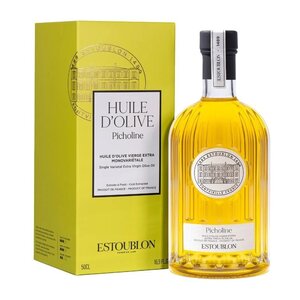
De Olijfolie Shop sells, among others, Château Margüi BIO and the single-variety Salonenque and Picholine olive oils from Château d’Estoublon. These oils show different flavour styles from Provence.
How should French olive oil be stored?
Store French olive oil in a cool and dark place. Close the bottle carefully after every use and protect it from sunlight, heat and air. Do not keep the oil next to the cooker or in front of a sunny window.
Read more
- What are polyphenols?
- Award-winning olive oil
- Organic olive oil
- What does extra virgin mean?
- Cooking with olive oil
- How should olive oil be stored?
Our favourite French olive oils
From an organic blend of six Provençal olive varieties to two expressive single-variety oils from a famous château, these three extra virgin olive oils show just how refined, versatile and distinctive French olive oil can be.


Discover the taste of France
French extra virgin olive oil may be less well known than olive oil from Spain, Italy or Greece, but it certainly does not fall short in quality or character. From elegant Salonenque from Provence to green, peppery Picholine and complex blends of local olive varieties, every oil tells the story of its château, grove and terroir.
At De Olijfolie Shop, you will find a carefully selected collection of French top-quality olive oils with a clear origin and their own flavour profile. Discover our French olive oils and taste how the refinement of French gastronomy can come to life in a bottle of extra virgin olive oil.