 Shop
Shop

Monocultivar: The purity of a single variety
When we speak of a monocultivar, the olive oil is made from just one variety. It is the purest way to get to know an olive variety. You smell and taste exactly what that one olive has to offer: sometimes it is distinctly fruity and mild, other times intense and green. It is an honest introduction to the soul of a specific olive variety.
The Blend: The maker’s masterpiece
This is where it gets interesting. In the world of industrial olive oil, a blend is indeed often a way to mask cheap leftover batches. But for world-class olive oil makers, a blend is a deliberate composition. It is a craft.
Imagine: the oil from the Arbequina olive is wonderfully fruity this year, but lacks just that hint of bite. A master producer then very carefully adds a few per cent of the powerful Picual or the characterful Cornicabra. The result? An olive oil that is in balance: a symphony of aroma and flavour that transcends any single olive variety.
The committee of wise men
At the best cooperatives, this is not left to chance. At the start of the season, a committee of ‘master tasters’ convenes. These are often the wise old men who have been doing this work for decades. They taste, discuss and fine-tune until the perfect blend for that specific harvest year is achieved. It is comparable to the famous ‘assemblage’ at major wineries: the maker creates a work of art.
Why you need not be wary of a blend
A high-quality blend is, in fact, a sign of craftsmanship. It is the balance that counts. Whether you opt for the pure expression of a single variety or the balanced complexity of a carefully composed blend: it is all about the maker’s intention.
Here are two examples of world-class blends.
Pago Baldios San Carlos’s De Oro is a blend of the fruity Arbequina olive with 10% Cornicabra. That 10% gives the oil so much more depth and flavour.
The Marqués de Valdueza is a blend of no fewer than four olive varieties. The exact composition varies each year. The committee of wise men (and women these days) determines the ideal ‘recipe’ anew each year to produce the very best olive oil.
Anecdote
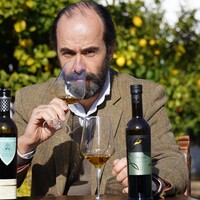
In the photo you can see Marquis Fadrique Álvarez de Toledo y Argüelles, owner of the estate, who is a direct descendant of the Duke of Alva and named after his son.
During his first meeting with the Marquis, he became irritated even as they were being introduced. His diary mistakenly listed an appointment with someone from Poland rather than Holland. After all, in his view, meetings with the Dutch were pointless. He was convinced that the Dutch and Belgians did not want to use his olive oil because his ancestor had occasionally had heads rolled in Brussels’ Grand Place and had made life rather miserable for ‘our’ William of Orange. Eventually, I managed to convince him that we don’t see things in such a gloomy light. Certainly not after 1 April 1572, when his ancestor lost Den Briel to the Watergeuzen..... Things are going very well between us now, by the way. Funny how a very posh marquis and a chatterbox get on so well :-)
Not sure which style suits your kitchen? Feel free to send me a message, and I’ll give you some personal advice.